
If you step into the world of Bridgerton, you are immediately swept away by a symphony of shimmering silks, scandalous gossip, and string quartets playing instrumental arrangements of Taylor Swift. It feels familiar, a lavish Regency romance from the school of Jane Austen. But look closer, and you’ll see that the most revolutionary thing about the series isn’t Lady Whistledown’s poison pen or the modern soundtrack. It’s the people themselves: a formidable Black queen on the throne, a dashing Black duke as the season’s most eligible bachelor, and a fully integrated, multiracial aristocracy, all navigating the intricate rituals of the London marriage market.
This is not a historical oversight; it is the entire point. And to understand its profound cultural impact, we need to move beyond a simple “book vs. show” comparison, take a look at the color-conscious casting and engage with the very politics of looking. We need to talk about representation.
To do this, we can turn to the work of the late, great cultural theorist Stuart Hall. For Hall, representation is not a simple mirror reflecting a pre-existing reality. Instead, he argued that representation is a constitutive process—it actively produces meaning. Media doesn’t just show us the world; it shapes our understanding of it. Bridgerton serves as a perfect case study for Hall’s theories, a grand spectacle that isn’t re-presenting the Regency era but actively constructing a new one. By using Hall’s framework, particularly his famous encoding/decoding model, we can unpack the immense appeal, the complex critiques, and the true, lasting legacy of Bridgerton’s world-building.

The Politics of Representation: Why a Picture is Never Just a Picture
Before diving in, it’s crucial to understand Stuart Hall’s central idea. For decades, many thought of representation in media as a question of accuracy or reflection. A “good” representation was one that faithfully mirrored reality. Hall fundamentally challenged this. He proposed that meaning is not inherent in an object or event; it is produced through language, signs, and images.
Think of representation as a system. The producers of media (encoding) “fix” a particular set of meanings onto their product—this is their preferred or dominant message. However, audiences (decoding) are not passive sponges. They bring their own experiences, beliefs, and social positions to the text, and can interpret it in several ways:
The Dominant Reading: The audience accepts the producer’s intended meaning wholesale.
The Negotiated Reading: The audience broadly accepts the preferred meaning but modifies it to fit their own unique context.
The Oppositional Reading: The audience understands the preferred meaning but completely rejects it, often because it conflicts with their own experiences or political standpoint.
Bridgerton is a masterclass in this process. The creators encoded a specific fantasy, and the global reaction is a living map of these different decoding strategies at play.
Encoding a New Regency: The ‘Great Experiment’ as the Preferred Meaning
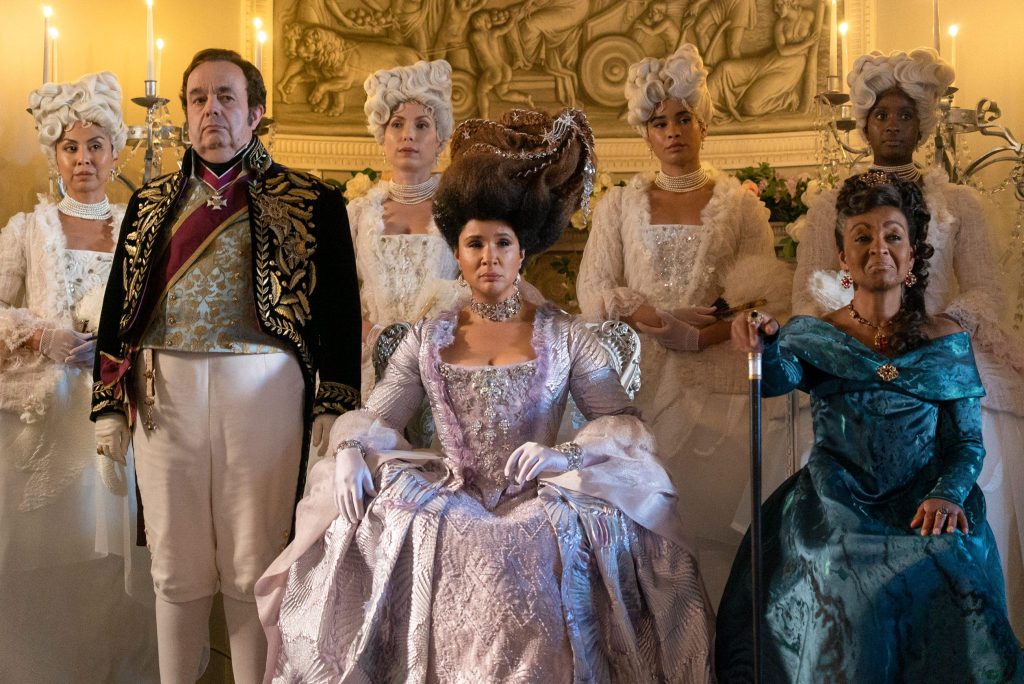
The producers of Bridgerton encode a very clear, dominant message: this is a fantasy of inclusion, where love, not conquest, changes the world. They constructed the lore to support this reading, most explicitly in the spin-off, Queen Charlotte: A Bridgerton Story.
Here, we learn the integrated society is the result of “The Great Experiment,” a social revolution sparked by King George III’s marriage to the Black princess, Charlotte. This isn’t just a fairytale; it’s framed as a fragile political project, championed by characters like Lady Danbury. “We were two separate societies, divided by color, until a king fell in love with one of us,” she explains. Her life’s work becomes ensuring this “experiment” succeeds, cementing the status of the new Black aristocracy.
This encoded meaning is aspirational. It suggests that racism is a surmountable obstacle, one that can be overcome by a single, powerful act of love and the subsequent political will to uphold it. The intended message is one of hope, escapism, and romantic universalism. This is the “product” Shondaland created, and its immense popularity is a testament to how many viewers were ready to accept this dominant reading.
Decoding the Fantasy: The Audience Reads Bridgerton
The global success of Bridgerton shows that the dominant reading is incredibly powerful. However, the discourse surrounding the show reveals a far more complex picture, perfectly illustrating Hall’s model.
The Dominant Reading: Unburdened Joy and Universal Desire
Millions of viewers have embraced the intended meaning of Bridgerton without reservation. For this audience, the show provides a profound sense of unburdened Black joy. In a media landscape where Black characters in historical settings are almost always depicted in relation to their suffering, Bridgerton offers a radical alternative. The Duke of Hastings has trauma, but it stems from his father, not his race. Queen Charlotte’s challenges are political, not racial. This reading celebrates the show’s decision to detach the tropes of Regency romance—the balls, the gowns, the grand love stories—from an exclusively white experience. It’s pure, joyful escapism, and its power comes from its refusal to be weighed down by the grim realities of history. It fulfills the fantasy that anyone can be the “diamond of the season.”
The Negotiated Reading: Loving the Fantasy, Acknowledging the Erasure
This is perhaps the most common position among thoughtful fans. This audience decodes the show by broadly accepting its joyful, romantic premise while simultaneously negotiating with its historical simplifications. A viewer in this position might say, “I love the representation and the romance, but I know it’s not real history.”
This negotiated reading acknowledges the pleasure of the fantasy while remaining aware of what that fantasy erases. The real Regency era (1811-1820) was the height of the British Empire, an economic powerhouse built on colonialism and the slave trade. The wealth that funded the balls and bought the diamonds was generated through violent exploitation. The negotiated reader enjoys the fictional world where a Black duke can exist, but they are also keenly aware that his real-life counterpart would likely have been either enslaved or fighting for abolition. This reading allows for a complex appreciation, one that holds both the beauty of the fiction and the brutality of the fact in mind at the same time.
The Oppositional Reading: Rejecting the Fantasy as Historical Gaslighting
Finally, there is the oppositional reading. This audience understands the encoded message of inclusive fantasy but actively rejects it as a dangerous and irresponsible act of historical erasure. From this perspective, Bridgerton doesn’t just ignore history; it sanitizes and “gaslights” its audience into accepting a palatable version of a monstrous era.
An oppositional reading would argue that presenting a Black queen and integrated aristocracy without ever mentioning colonialism or slavery is not a “fantasy” but a harmful distortion. It allows a modern audience to consume the aesthetics of empire without confronting its moral horrors. Furthermore, this reading often points out the show’s class problem: the “Great Experiment” only seems to apply to the 1%, while the working class remains largely white and invisible. For this viewer, the show’s representation is a hollow, even insulting, gesture that papers over the very real structures of race and class that defined the period.
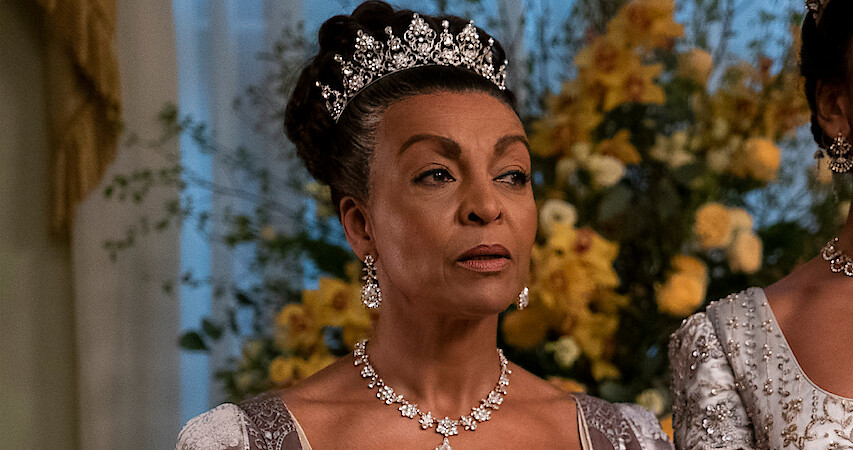
Beyond Archetypes? Stuart Hall and the ‘Spectacle’ of the Black Aristocrat
Another key element of Stuart Hall’s work is his analysis of stereotyping. He argued that stereotypes reduce people to a few simple, essentialized traits, fixing them as “different” or “Other.” Stereotypes can be negative (the lazy worker, the criminal) but also seemingly positive (the naturally gifted athlete, the wise elder). The question for Bridgerton is: does it escape stereotyping, or does it simply create a new, spectacular kind of “positive” stereotype?
On one hand, the show gives its characters of color complex inner lives. Simon Basset’s journey is a deep-dive into generational trauma. Kate Sharma’s story is about the burden of familial responsibility. These are universal themes.
However, one could apply Hall’s critique and argue that these characters are often slotted into pre-existing white literary archetypes. Simon is a classic Byronic hero—the dark, brooding rake with a painful past. Kate is the fiery, headstrong shrew who must be “tamed” by love. Are these nuanced characters, or are they familiar templates simply filled by actors of color? This is what Hall might call the “spectacle of the other”—the presentation of non-white characters is still framed by the dominant culture’s narrative conventions. The show’s success comes from its mastery of the romance formula, and part of that formula involves recognizable archetypes. The debate is whether the characters transcend these archetypes enough to feel truly new.
Constructing a New Canon: Bridgerton’s True Legacy
So, what is the ultimate legacy of Bridgerton when viewed through the lens of Stuart Hall?
The show’s triumph is not that it reflected a hidden historical truth, but that it so powerfully and successfully constructed a new one. It is a stunning real-world example of representation’s constitutive power. Bridgerton has fundamentally altered the meaning of “Regency romance” for a global audience of millions. It has shifted the baseline. The expectation for future period dramas has been changed; all-white casts now feel like a deliberate, and perhaps pointed, choice rather than a historical default.
The show’s creators encoded a message of inclusive fantasy. Audiences decoded it in dominant, negotiated, and oppositional ways, creating a vibrant and necessary global conversation. Bridgerton has successfully challenged the gatekeepers of historical drama, proving that there is a colossal appetite for stories that prioritize modern emotional relevance over strict factual accuracy. It has become its own form of canon.
Its most enduring legacy, therefore, is not the specific characters or plotlines. It is the irrefutable demonstration that media doesn’t just hold a mirror up to the world. It holds the power to build a new one, right before our eyes.
Your Turn
How do you decode Bridgerton? Do you find yourself adopting a dominant, negotiated, or oppositional reading of its world? What does the show’s representation mean to you?
Share your analysis in the comments below!