
Love. What is love? This is a question we human beings have been struggling to find answers to since the beginning of time. It doesn’t really matter where you come from, or how old (or young) you are. You probably have a general sense of what love is, right? It’s a feeling that can lift us to the highest heavens or leave us stranded in the depths of despair, they say. And it has transcended time and cultures. What about the relationship between existentialism and love?
Let’s briefly set the stage. Existentialism, a philosophical perspective that emerged in the 20th century, seeks to unravel the mysteries of human existence. It grapples with the fundamental question of how we find meaning in a world that often appears confusing and indifferent. It’s as if we’re trying to decipher a complex puzzle while navigating life’s ever-changing landscape. Existentialism has a lot to offer in terms of our being.
Are you sometimes in search of a meaning for life or a purpose? What does it mean to pursue a purpose? It all boils down to existentialism. We have heard the word “existentialism” at least once in our lives, right? But to take a deeper look at it: Existentialism is a philosophical movement that emerged in the 19th and 20th centuries as was primarily associated with thinkers like Jean-Paul Sartre, Albert Camus, and Friedrich Nietzsche. It mainly focuses on the individual’s experience of existence, emphasizing themes like freedom, choice, authenticity, and the inherent meaninglessness and absurdity of life. Notably though, many including Camus argue that this meaninglessness of life must not impede our thriving. Since the world is so absurd, why bother and take it so seriously anyway? Instead, it’d be much better if we take a chance, experience and enjoy life while it lasts.
Want to know about the relationship between existentialism and love and the meaning of existential love? Let’s move on to what has brought us here today: existential love in Woody Allen’s movies. What are the key elements of love in its existential meaning? In its existential sense, love can be defined through elements of authenticity, freedom, responsibility and absurdity. But let’s delve into the meaning of existential love extracted from Woody Allen movies to see what it really refers to.
1. Absurdity of Life and Existential Love
Existentialism acknowledges life’s inherent absurdity, and highlights the challenges of finding meaning and purpose in a world that often appears chaotic and nonsensical. Woody Allen movies masterfully portray this theme through humor and irony, infusing a touch of fun into the contemplation of life’s absurdities.
As Camus suggests, the search for meaning is a human struggle with the phenomenon of absurdity. In his Myth of Sisyphus published in 1942, Camus says “This world in itself is not reasonable, that is all that can be said. But what is absurd is the confrontation of this irrational and wild longing for clarity whose call echoes in the human heart. The absurd depends as much on man as on the world. For the moment it is all that links them together”. Love, then, becomes one of the means by which we engage in this struggle against the absurdity of life. Therefore, he implies that we should not stop exploring the world and the possibilities it offers. Rather, we should overcome the absurdity by taking our chances, and keep on looking for our meaning, despite the fact that the world will never really surrender any specific meaning to us.
Woody Allen’s Manhattan, released in 1979, mainly explored the themes of love and existential tendencies in the backdrop of New York City, Allen’s favorite city. We have Isaac Davis (played by Allen himself), facing a crisis in his romantic life. He is basically caught between his attraction for a high school student (Tracey) and his complicated relationship with Mary, who is already having an affair with his married friend. So, from the very beginning we are faced with the concept of existential love and absurdity of life in this film.
In Manhattan, the characters navigate the absurdities of life within New York City’s intellectual elite. The film’s humor stems from their quirky interactions and misunderstandings, highlighting the existentialist recognition of the absurdity of love and the human condition. They talk about absurdity of life, how to find love, and the meaning of love itself. Love is depicted as a complex, messy, and sometimes irrational endeavor, mirroring the absurdity of existence itself.
Annie Hall is another movie by Allen, released in 1977. The leading actor is Woody Allen himself and the leading actress is Diane Keaton. Similar to Manhattan, in Annie Hall, Alvy Singer’s witty and humorous monologues and dialogues punctuate the film, offering a humorous take on the absurdities of human relationships. The characters’ quirks and idiosyncrasies exemplify the complexities of love within life’s contradictions. Through humor, the film presents the existentialist idea that love, despite its absurdities, remains a fundamental aspect of human existence. It suggests that the relationship between existentialism and love is an important one; something we are constantly living.
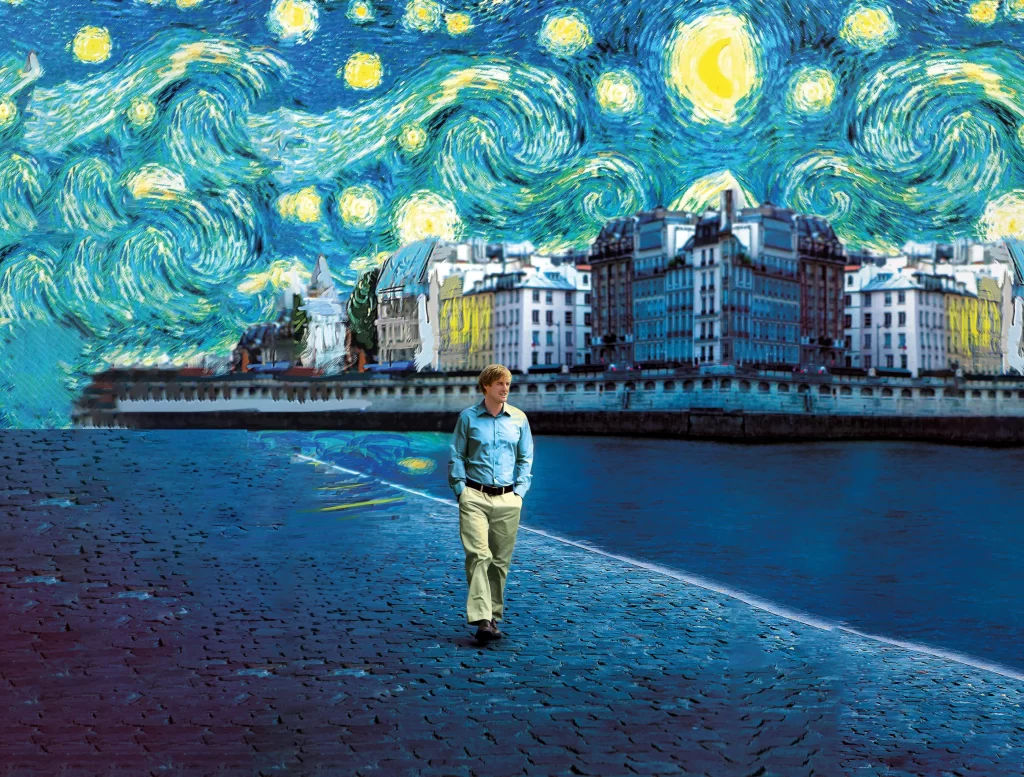
The same is true about Midnight in Paris (released in 2011). The film’s protagonist, Gil Pender, portrayed by Owen Wilson, finds himself caught in the web of nostalgia and time travel, which, in itself, is an absurd concept. Each night at midnight, Gil is transported to 1920s Paris, where he mingles with luminaries of the past, including Ernest Hemingway, F. Scott Fitzgerald, and Salvador Dalí. This surreal time-traveling adventure truly depicts the absurdity of his experiences. Imagining one could time travel is quite absurd, isn’t it? Yet, it is what Gil does every night and however unbelievable, seems to be enjoying it while it lasts.
The absurdity extends beyond the time-travel premise. Gil’s fiancée, Inez, and her family, who symbolize contemporary materialism and conformity (constantly talking about what products to buy, which house or car to purchase, which rich family to hang out with and so on!) cannot really understand his fascination with the past. They more or less represent the banalities of modern life, a stark contrast to the glamorous world of 1920s Paris. This dichotomy highlights the absurdity of Gil’s existence and his longing for a different time.
2. The Search for Meaning; the Cornerstone of Existentialism
At its core, Midnight in Paris revolves around the search for meaning. As mentioned, Gil, a successful screenwriter, is discontented with his present life, longing for the artistic vibrancy of 1920s Paris. His journey through time becomes a quest to find meaning and purpose in his existence. Questions like, “Who am I, really?” or “What am I doing in this world?”. This basically reflects existentialism’s central question: how do we derive meaning in a world that often seems bewildering and indifferent?
In Manhattan, Isaac’s relationships with Mary, Tracy, and others become a canvas on which he paints his pursuit of meaning. Haven’t we all, at some point, tried to find our purpose by forming connections with specific individuals or immersing ourselves in relationships that hold the promise of significance?
So, this is pretty much what love is to Isaac. it gives him a reason to look for meaning. Existentialism suggests that individuals must create their own meaning in life. In Manhattan the characters are on a quest for meaning within their relationships. Isaac is constantly preoccupied with the thought of Tracey being younger than him and “having a whole life” ahead of her. This is the main reason why he repeatedly tries to end his relationship with her. Yet, he mentions that Tracey is the one with whom he can forget about everything and just enjoy himself in every situation. At some point, Tracy’s character symbolizes the idea that love can provide a sense of meaning and transcendence in the face of life’s uncertainties.
But what is the ultimate meaning of love in this context? Could it be that the search for meaning itself is a fundamental aspect of human existence? To put it simply, love is essentially a form of looking for meaning. Allen’s pursuit of meaning through love is quite evident in Manhattan when Isaac’s search for meaning is depicted via the relationships he gets himself involved in. Haven’t you ever tried to find your own meaning by getting into relationships or befriending certain people? Isaac cherishes Tracey for her innocence. She’s still a kid, as he himself says. But he also notes that the best moments of his life are those spent with her.
The same is true about Woody Allen’s Annie Hall. In the context of romantic relationships, both Alvy and Annie are in search of meaning. They desire fulfillment and understanding, but they also grapple with the complexities and contradictions of love. This existential quest for meaning is highlighted by moments of introspection, self-doubt, and the recognition that love is not a straightforward path to happiness. Throughout the film, Alvy reflects on his past relationships and tries to make sense of the choices he has made. This existentialist pursuit of meaning through introspection is particularly evident when Alvy describes how he had spent his childhood, how his previous relationships were and what mistakes he or his partners had made.
He seeks fulfillment and understanding through these connections, but they often lead to confusion and uncertainty. This is another existentialist notion that the search for meaning can be a challenging and even elusive endeavor. Annie Hall ultimately suggests that the search for meaning in love and relationships is an ongoing pursuit. It reflects the existentialist idea that individuals must create their own meaning in life and if they’re lucky enough, they can do so by reaching a balance between existentialism and love.
In Midnight in Paris, Gil’s fascination with the 1920s, often referred to as the “Golden Age,” represents his longing for a time when creativity and intellectualism flourished and gave humans a reason to exist. This era, embodied by luminaries like Ernest Hemingway, F. Scott Fitzgerald, and Gertrude Stein, becomes the backdrop for his search for meaning. He seeks validation and inspiration in the company of these figures, hoping to find the essence of creativity and artistic fulfillment and love itself, things he believe are the meanings of life.
Existentialism and love are intertwined in Woody Allen’s Midnight in Paris. Throughout his time-traveling adventures, Gil engages in philosophical conversations about art, literature, and life’s meaning with those figures he encounters. These discussions serve as a vehicle for exploring existential questions. Gil struggles with the idea that perhaps he was born in the wrong era, a sentiment many individuals can relate to, as they seek to find meaning in a world that often feels indifferent or chaotic. The fact that he cannot connect with his fiancée is yet another reason why he is searching for a more profound meaning of love. To me, this is what makes Woody Allen movies so fascinating, always showing a complex human endeavor which we can more or less relate to.
3. Freedom of Choice and Woody Allen Movies
Most Woody Allen movies try to subtly show how we are constantly faced with the consequences of the choices we make. It is a significant aspect of the relationship between existentialism and love. In Annie Hall for example, the couple (Alvy and Annie) choose to be together, even though their personalities and interests sometimes clash. And then they choose to take a break. This freedom to choose and the resulting conflicts exemplify the existentialist idea that love involves personal freedom and responsibility.
Authentic love is an act of free will, where you acknowledge your ability to choose your romantic partner and accept the responsibility that comes with that choice. In Manhattan, Mary, the woman Isaac develops an infatuation for is also in another relationship first, with Isaac’s friend, Yale who happens to be married! What does she do when she meets Isaac? She chooses to go out with him. Does she love him? Probably just a transitory phase of infatuation. Why? Because she still struggles to choose between Yale and Isaac. At some point, she breaks up with Yale, saying that she has realized her worth and that being with a married man is beneath her.
So, she starts a more serious relationship with Isaac. And what happens next? She figures that her feelings for Yale were deeper than she thought and she still loves him. She breaks up with Isaac and goes back to Yale who has just gotten a divorce because of her. This is what existentialists mean by free will. We live to make choices. Are all of our choices for the best? Probably not. But, this is basically what we do and who we are.
So, what happens to Isaac in Manhattan? He finally realizes that Tracey is the one he has been looking for. A person with whom he can share his thoughts, spend quality time and enjoy life. That is the meaning of love to him, right? Although love looks much more complex than this, but what if it’s not? If you look for the meaning of your existence and you happen to find a companion to go through this task throughout your life, maybe that is enough. He first breaks up with her to have a temporary relationship with Mary, when he suddenly realizes he had mad a mistake. He takes responsibility and admits his mistake, then goes to be with her. Isaac’s dilemma during the film and the decision he makes mark the element of freedom and choice in love. As existentialists say, we must make choices and are actually making choices nonstop throughout our lives, and as a result, we should take responsibility for our decisions and the actions we take.
In Woody Allen’s Midnight in Paris, Gil’s ability to transport himself to a different era represents a form of escapism and the exercise of personal freedom. Each midnight, he has the choice to return to the past or remain in the present. This recurring choice serves as a metaphor for the broader theme of freedom in the film. Gil’s decision to explore the past reflects his desire to exercise his freedom to seek inspiration and authenticity.
Even the events he faces during his time travels manifest themes of free will. For example, Ernest Hemingway’s character embodies the idea of living life to the fullest and pursuing one’s passions with vigor. Hemingway’s famous quote, “There is no friend as loyal as a book,” underscores the freedom to choose one’s pursuits and live authentically.
Gil’s recurring choice to explore the past serves as a poignant reminder that the exercise of freedom can lead to unexpected adventures and profound revelations, ultimately shaping one’s path toward a deeper understanding of life and love. In Gil’s Case, he happily chooses to end his relationship with the person he finds nothing in common with and start a new life in a new city with a new person freely, and this beautifully demonstrates the relationship between existentialism and love.

4. Authenticity & Self-discovery; the Journey Within
Want to explore more about authenticity? What it ultimately means is that authenticity is about accepting and embracing this existential condition we are in. To be more specific, it means there’s no such thing as soulmates, perfect matches, or other halves. All there is an infinite number of choices we are free to choose. It is our subjectivity that determines who we are going to end up with, or at least, we’re willing to spend a specific period of time with. Jean-Paul Sartre says, “That is the essence of the joy of love, when it exists: we feel justified to exist.” We must primarily recognize our freedom and that of others around us. Therefore, authenticity in existential love simply means regarding ourselves and others as free subjects making self-defining choices and leading free lives. Embracing this freedom is a cornerstone of existential love.
Tracy, the girl Isaac finds himself in love with, symbolizes the idea that love can provide a sense of meaning and transcendence in the face of life’s uncertainties. Isaac’s evolving relationship with Tracy becomes a catalyst for his own self-discovery and pursuit of authenticity. He sees as a source of authenticity in a world filled with complexities and moral ambiguities. Isaac’s second ex-wife (acted by Meryl Strip), left him for another woman. That is how she has found her authenticity—by deciding to leave her husband for a woman. Isaac’s friends and acquaintances have their own quirks and idiosyncrasies, and their choices in love and relationships reflect their individual quests for authenticity. The complexities and entanglements Mary struggles with also highlights her journey of self-discovery and finding one’s authenticity.
But wait, it all gets even more interesting in Annie Hall, where Alvy’s journey of self-discovery is central to the film’s narrative. He struggles with questions about his own identity and the authenticity of his relationships. This existentialist theme is particularly evident when Alvy explores his past through flashbacks, attempting to make sense of the meaning of his past loves. The film also shows his therapy sessions and how he is attempting to make sense out of his authentic existence. Alvy also recommends Annie to give therapy a chance, which as a result, Annie undergoes a transformation, shedding her previous persona and discovering her own sense of identity and independence. It is then that she decides to end her relationship with Isaac to find her truest self. This journey toward self-discovery resonates with existentialist ideas about individuals defining themselves through their actions and choices.
We also have therapy session scenes in Manhattan. These scenes serve as a window into Alvy’s internal struggles and quest for authenticity. Alvy reflects on his past relationships, his upbringing, and his anxieties, and it all boils down to the existentialist theme of self-examination. His desire to understand himself better and make sense of his choices are what give meaning to authenticity in existential love.
In Midnight in Paris, Gil’s time-traveling adventures become a metaphorical journey toward authenticity as well. The character of Adriana, portrayed by Marion Cotillard, adds depth to this exploration of authenticity. Adriana, too, seeks a different era, longing for the Belle Époque of Paris. Her desire for an idealized past mirrors Gil’s own yearning for a more meaningful existence. Their shared pursuit of authenticity leads to a romantic entanglement that challenges their perceptions of time and reality. Authenticity knows no boundaries, and of course, no time limits. You realize you are alone and free in this world, and you have to act toward others using this perception.
Midnight in Paris ultimately suggests that authenticity and self-discovery can be found in one’s present moment. Gil’s decision to embrace his love for writing and follow his heart shows how he is exercising authentic desires. He ultimately decides to follow his authentic path without regret. He lets go of his previous entanglements and embarks on a journey to find who he really wants to be. The film actually encourages us to consider that the pursuit of authenticity can be a journey that unfolds in unexpected ways, and can bring us to a more profound understanding of ourselves and consequently, of others.

The three movies I wrote about are among Woody Allen best movies. Overall, his films provide a rich tapestry for exploring the intricate relationship between existentialism and love. Through humor, wit, and intellectual depth, these entertaining yet profound films invite us to contemplate our own existential journeys, the absurdities of life, the search for meaning, the exercise of personal freedom, and the pursuit of authenticity. They remind us that love, in all its complexity and imperfection, remains a fundamental aspect of the human experience—a signal light of meaning in a world that often appears bewildering and indifferent. So, when was the last time you went through an existential experience with love? Next time you do, embrace it.